.png)
Shared Streets, Shared Responsibility: Dialogue Concerning Off-Campus Student Housing
By Chase Quigley and Katherine LaDuke
As part of NERLab’s ongoing work, we regularly attend community meetings and events to listen and learn how residents talk about Providence College (PC) and their expectations of the institution in the broader context of neighborhood and community life. Meetings we regularly attend include:
Smith Hill Partners’ Initiative
Ward 12 Community Meeting
Ward 14 Community Meeting
Ward 14 Student Housing Task Force
These community meetings, alongside our interviews with local residents, have surfaced several community-identified priorities and ongoing initiatives, including the impact of off-campus student housing in the 02908 neighborhoods. Specifically, this concern relates to gentrification, displacement, demolition, the lack of affordable housing, and the everyday quality of life for neighborhood residents — issues that many feel have been increasingly exacerbated by the expansion of off-campus student housing. In fact, for the third year in a row, the Providence Preservation Society recently identified the 02908 neighborhoods surrounding PC on their “Most Endangered Places” because of the impact of investor-owned housing geared to students. (The Providence Preservation Society's annual Most Endangered Places “bring[s] attention to vulnerable places and pressure points across the city that are of architectural, historic, or cultural significance to their communities.”)
The Ward 14 Student Housing Task Force, which began meeting around the same time as our research was taking shape in Spring 2024, has since researched and recommended several ordinances to the Providence City Council to help mitigate these concerns, many of which are inspired by the policies of other cities that have a high volume of off-campus student housing, including Boston. Some of the policy recommendations that are being considered include:
Student Housing Overlay District: This proposal would establish a boundary on the continued expansion of student housing in a specific area. The boundary lines would be added to existing zoning regulations, along with additional standards to guide future development within the overlay district.
Student Housing Licensing: This proposal would require landlords who rent properties exclusively to students to obtain a license from the City. The license would cost $500 per property per year and would be paid by the property owner.
Student Housing Special Permit Use: Instead of charging an annual licensing fee, the Council is also considering requiring student housing properties to apply for a special permit. A special permit would allow the City to track and maintain records of student housing properties, but it would not include a yearly fee like the licensing proposal.
Student Impact Fee: This proposal would create a $300 annual fee per student tenant in student-only housing. The fee would be charged to landlords or developers. Property owners who fail to comply could face fines of up to $500 a day. The proposal would also require colleges and universities to provide the City with lists of students living off campus.
The Student Housing Task Force was created by Ward 14 Councilwoman Shelley Peterson to bring community members and campus stakeholders (students, faculty, and administration) into conversation and enable them to advocate for their positions regarding policy changes that would affect student housing — not only in Ward 14 (which includes nearly all of PC’s off-campus student housing on and around Eaton Street), but also throughout the City of Providence given the density of colleges and universities embedded in our urban neighborhoods. NERLab team members regularly attend these meetings to better understand how this issue is perceived by and impacts local community members — and to consider the institution’s responsibility in helping to address this issue.
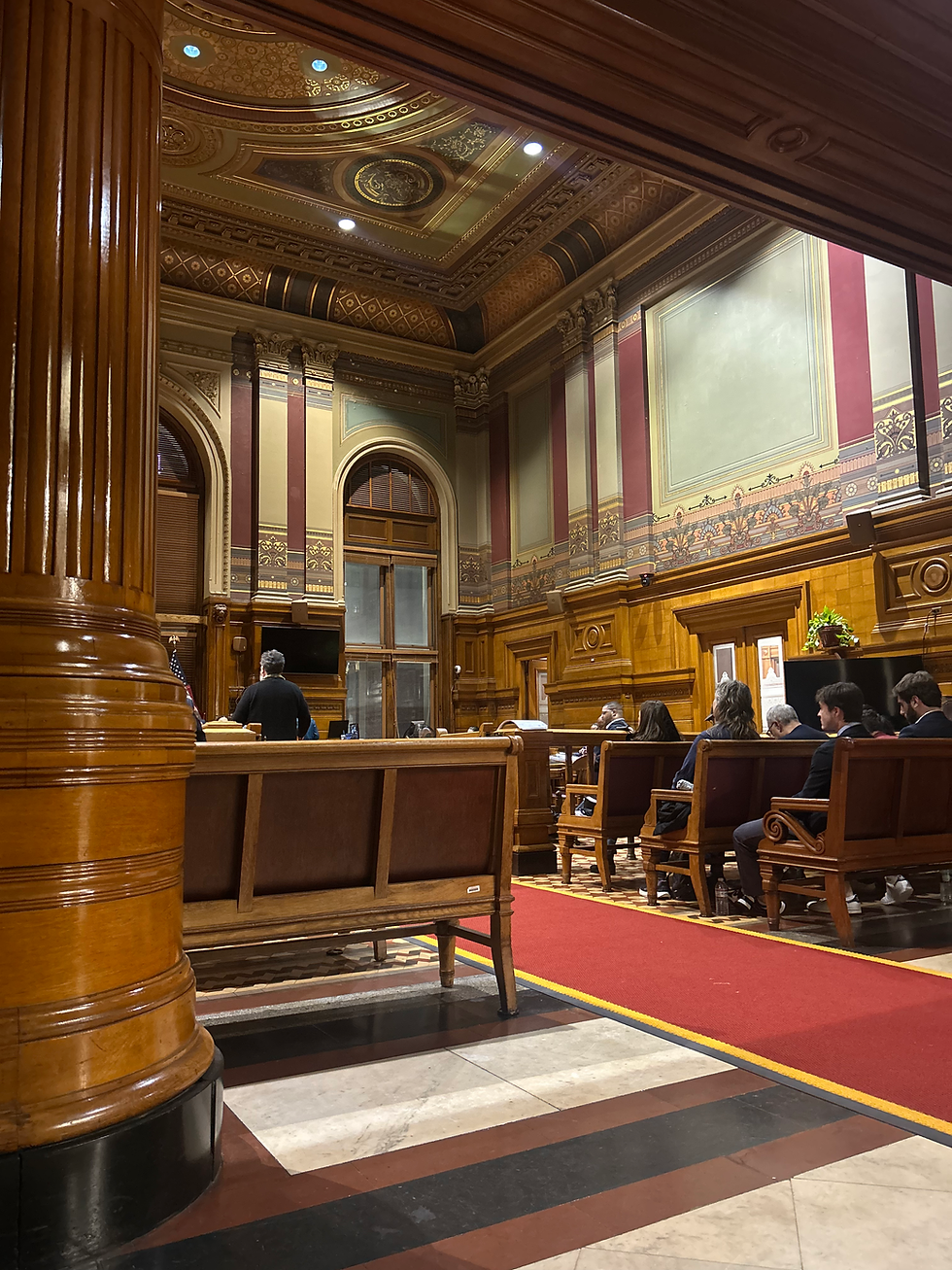
The conversations at these meetings, and the tireless work done behind the scenes, came to a head on November 13, 2025, when community members, students, and landlords packed Providence City Hall for a public hearing held by the City Council Ordinance Committee. Although the ordinance and its proposals are nuanced, as highlighted above, the hearing focused almost exclusively on the Student Impact Fee. Testimonies lasted several hours, with residents emphasizing the strain that student housing has on neighborhood life, and students and landlords focusing on the financial implications inevitably posed to students, as any housing fees are often reflected in rent prices. This is an issue that continues to draw attention from campus and community members and will be followed by additional public hearings later this year on the other policy recommendations noted above.
Like many college campuses situated within residential neighborhoods, it is common for students to live off campus. As off-campus housing options become more available and even desirable, these trends have no doubt contributed to the shifting landscape of affordable housing and corporate expansion that ultimately endangers communities. In the case of PC, while students are required to live on campus for their first three years, many seniors choose to live off-campus not only because of an impressive variety of options, but also because of the lack of senior-designated housing on campus.
That being said, students (and even faculty) comprise a considerable part of the population surrounding PC, making them an immovable part of the neighborhood — and making them neighbors for a portion of the year. Despite the transience inherent in the intersections of higher education, NERLab is continually working toward ways to build community and foster neighborliness across these boundaries. A meaningful first step can begin with educating oneself about the realities behind local events and what they mean for long-term residents.
Although the impact of off-campus student housing has made our local neighborhoods “endangered,” and we understand the importance of the Providence Preservation Society’s annual Most Endangered Places, we also want to pause to ensure “endangered” is not misconstrued on campus. While preservation, reinvestment, and revitalization efforts are active in changing the makeup of the 02908 neighborhoods, we must remind ourselves of “the architectural, historic, or cultural significance” that drives their very protection. It is by no means to write these communities off as “dangerous” or “extinct” (as some might perceive on campus), but provides us with a unique opportunity to recognize what continues to thrive through all this change.
NERLab, and the Department of Public and Community Service Studies at PC, is centered around an asset-based community lens. This framework focuses on identifying existing resources and strengths in communities to support public problem-solving, emphasizing greater equity and collaboration in relationships rather than framing communities in deficits, needs, or problems (Kretzman & McKnight, 1993). As we have been speaking with residents about what it means to be a good neighbor in local libraries and the PC/Smith Hill Annex, NERLab has had the pleasure of seeing these assets firsthand — people, places, histories. In all our work, we are looking to centralize and uplift what already exists throughout the 02908 neighborhoods, not just for individuals on campus, but in the hope that all of us can come together on shared ground — considering how much physical ground we share after all.
Several resources on the NERLab website showcase relevant community assets spanning across Smith Hill, Wansuck, and Elmhurst. For example, check out information on neighborhood histories or discover your new favorite local businesses on the 02908 Small Business Map. Interested in joining the next Ward 14 Student Housing Task Force meeting? Check out our Community-Campus Calendar for upcoming dates and details. You can also join us on April 10 for a Smith Hill Neighborhood Walking Tour. There is a lot we can learn alongside one another, but this requires an openness to learning about the communities and neighborhoods we are a part of.
There is no simple solution to the challenges surrounding off-campus student housing. While policy changes play a role, so do communication, coordination, accountability, and sustained engagement. If proximity alone is not enough, perhaps a more neighborly presence between institutions, relevant economic stakeholders, and community leaders and members alike can help sustain a more reciprocal relationship and collaborative solutions to the off-campus student housing issue. The work begins with conversation and continues with what we choose to build together.
Reference
Kretzmann, J. P., & McKnight, J. L. (1993). Building communities from the inside out: A path toward finding and mobilizing a community’s assets. ACTA Publications.
Chase Quigley is an undergraduate student in the Class of 2026 at Providence College, double-majoring in Political Science and Public and Community Service Studies. He is a Research Fellow in the Neighborly Engagement Research Lab (NERLab) at Providence College.
Katherine LaDuke is an undergraduate student in the Class of 2027 at Providence College, majoring in Public and Community Service Studies, with a minor in Communications. She is a Research Fellow in the Neighborly Engagement Research Lab (NERLab) at Providence College.


Comments